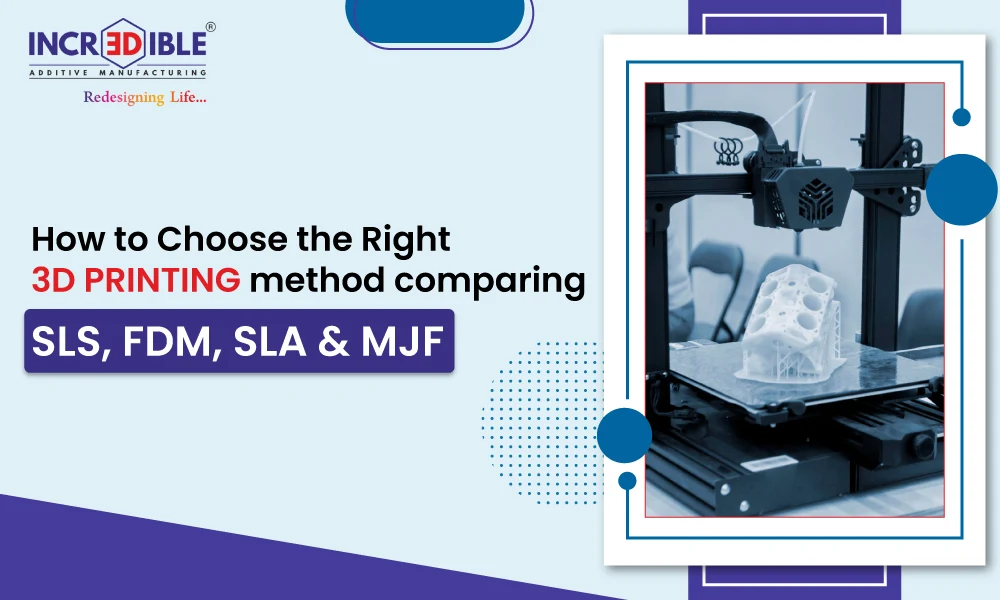
The right 3D printing method can completely shape the performance, finish, and cost of your product. Each technology—SLS, FDM, SLA, and MJF—offers its own strengths, whether you’re building functional prototypes or end-use parts.
“Each 3D printing method tells a different story—of precision, durability, and design freedom.”
SLS: Strength and Industrial-Grade Precision
Selective Laser Sintering (SLS) is known for producing strong, durable nylon parts using a high-powered laser to fuse polymer powder.
Best for: Essential prototypes, automotive parts, medical components.
Surface Finish:Matte surface finish, slightly rough but highly functional.
Application: Used in aerospace to create lightweight structural brackets that withstand high mechanical stress.
SLS is ideal when mechanical strength and design freedom are top priorities.
FDM: Economical and Entry-Level 3D Printing
Fused Deposition Modeling (FDM) is the most accessible 3D printing service in India, perfect for quick and affordable early-stage models. It works by extruding melted thermoplastic layer by layer.
Best for: Concept models, jigs, fixtures, prototypes.
Material Choices: ABS, PLA, PETG—each offering varied strength and finish options.
Scenario: Engineering teams often rely on FDM for fast, functional samples during early design phases.
Its simplicity and low cost make FDM a popular choice for small businesses and design teams needing fast turnaround.
SLA: High-Detail, Smooth, Aesthetic Finishes
Fused Deposition Modeling (FDM) is the most accessible 3D printing service in India, perfect for quick and affordable early-stage models. It works by extruding melted thermoplastic layer by layer.
Best for: Concept models, jigs, fixtures, prototypes.
Material Choices: ABS, PLA, PETG—each offering varied strength and finish options.
Scenario: Engineering teams often rely on FDM for fast, functional samples during early design phases.
Its simplicity and low cost make FDM a popular choice for small businesses and design teams needing fast turnaround.
MJF: Fast, Precise, and Production-Ready
Multi Jet Fusion (MJF) is an advanced industrial plastic 3D printing service technology known for speed, detail, and uniform strength. It does not print using inkjet alone—rather:
MJF uses:
Fusing agent
Detailing agent
Infrared lamp
These agents are deposited by inkjet heads onto powder material before being fused, resulting in high-strength, high-precision plastic parts.
“MJF blends innovation with performance, delivering parts that redefine additive manufacturing.”
It is regarded as one of the best choices for consistent, production-grade polymer components.
The Advantages of Choosing the Right 3D Printing Method
Increased Productivity: Faster prototyping speeds with reliable results.
Material Optimization: Matches the right material and method for each application.
Greater Product Reliability: Each technology provides consistent output aligned with performance needs.
Conclusion
Selecting the right 3D printing technology is not just about materials—it’s about balancing performance, cost, finish, and purpose. Whether SLS for industrial-grade nylon, FDM for cost-effective models, SLA for visual perfection, or MJF for fast, production-ready parts, each method brings unique advantages.
Summary:
SLS provides strong industrial-grade nylon parts
FDM is cost-efficient for early prototypes
SLA offers exceptional visual and surface detail
MJF delivers fast, accurate production-ready components
For expert guidance and the ideal printing approach for your project, 3D Engineering remains your trusted partner in precision, performance, and innovation.