How Custom 3D Printed Models Improve Design Visualization?

How Custom 3D Printed Models Improve Design Visualization

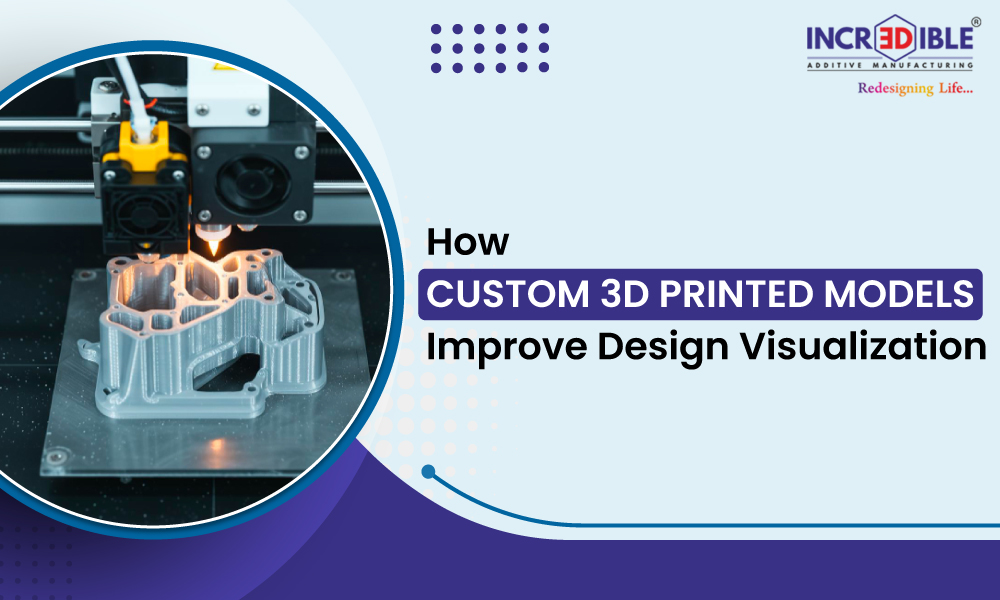
Digital screens and 2D drawings usually do not give designers all the flexibility to express ideas. Ideas can be flawless on the computer screen but fail to present scale, depth, and details in reality. This is filled with Custom 3D Printed Models, which transform the virtual designs into tangible objects that allow investigation of their design models at all angles. This allows the teams to make improved decisions about the design faster and more accurately through 3D printing for design visualization.

“3D printed models transform concepts into tangible forms, making design visualization clearer than ever.”

Physical Models Enhance Understanding

The 3D visualization of a design enables stakeholders to understand scale, proportions, and structure more than visualizations on the screen. Physical models are used in pinpointing the possible flaws in the early stages, avoiding the occurrence of expensive errors in the manufacturing process with the help of rapid prototyping services.

As an example, an architectural company may develop a 3D Printing services model of a building to demonstrate to the clients how spaces can be used. Equally, a firm in product design will also be in a position to print a prototype on which to test ergonomics, to be visualized, and get ready to manufacture goods for better product design prototyping.

Rapid Iterations and Feedback

Custom 3D Printed Models
  • The 3D printed models can be customized to accelerate the design process through the creation of numerous models in a short period of time using 3D printed prototypes. This is to guarantee improvements and faster feedback.

    There are several benefits to using physical models when discussing in a team or presenting a project to a client:

    • Quick Prototyping—Designers are enabled to print various versions of an item to establish which ones perform best without having to wait.
    • Real-Time Feedback—The model provides teams and clients with an opportunity to interact with the model and propose improvements before production.
    • Error Detection—Design defects are exposed at an early stage, and there is a lesser chance of expensive rework.

Communication Across Teams

  • The task of sharing complicated designs with engineers, marketers, or customers is usually difficult. 3D Printed Models for Visualization offer a reference that is easy to touch and physically visible, which enhances teamwork and makes everyone see the picture.

    An example is where an automotive company can 3D print a scale of an element in a car to translate to engineers on how to assemble it. Equally, the designers of furniture can present functionality and aesthetics to customers using the architectural 3D models.

    “3D printed models act as a universal language, making collaboration and communication seamless.”
Key Benefits

3D printed models designed in a custom format have distinct benefits, enhancing design processes and visualization:

    • Enhanced Understanding—Physical models create ease in comprehending complicated designs.
    • Swifter Cycles—Rapid printing can be used to test and to get feedback on various prototypes.
    • Enhanced Cooperation—Physicalized models make sure that all members of the team have the same vision.
    • Cost Savings—The designer can find errors early, before they lead to very costly design errors.
    • Client engagement models impress the clients and allow them to imagine the end product.

Conclusion

Custom 3D Printed Models

Custom 3D Printed Models aid design visualization; they bring ideas into reality to make them easier to visualize, enhance collaboration, and can also be used to make faster iterations. This will result in improved decision-making, reduced mistakes, and improved final products.

Quick Recap

  • Physical models enhance the knowledge of scale and detail.
  • Prototyping can be done faster due to rapid iterations.
  • Custom 3D printed models strengthen team communication and client engagement.
  • Cost-effective prototyping reduces errors before production.

Manufacturers and designers looking to optimize design workflows should consider 3D engineering for the best solution.

    Comments are closed.

    WhatsApp chat
    Become Channel Partner