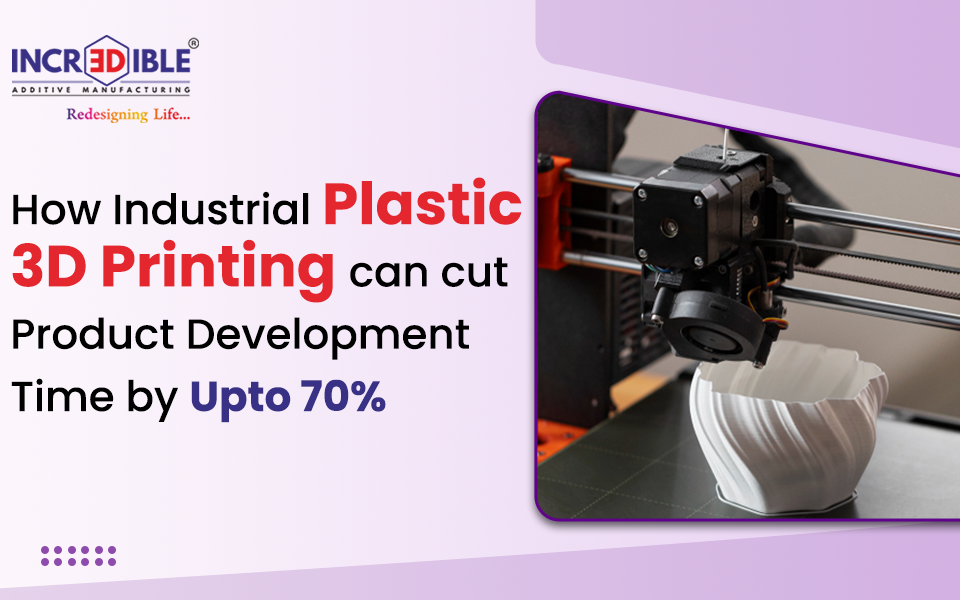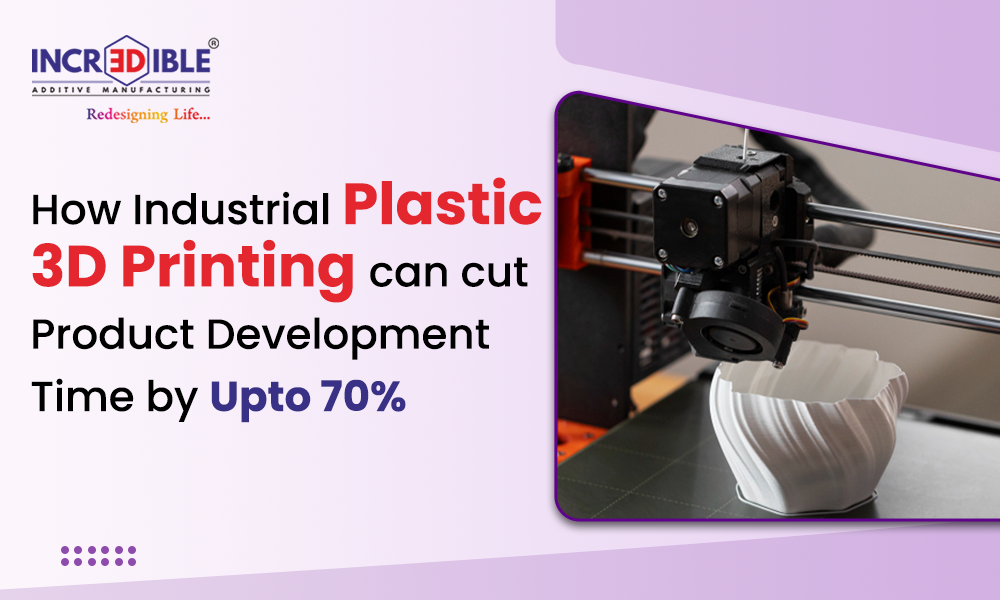
Bringing a new product to market has always been a race against time. Traditional manufacturing often involves tooling, machining, and repeated design revisions that can stretch development timelines over several weeks or even months. Today, industrial plastic 3D printing is helping manufacturers move faster by enabling rapid prototyping, functional testing, and design validation within days with plastic printing in India. The result is a product development process that can be up to 70% faster, allowing businesses to innovate with greater confidence.

“The faster you test an idea, the faster you can build a better product.”

Rapid Prototyping Speeds Up Product Validation

The biggest advantage of industrial plastic 3D printing is the ability to transform digital concepts into physical prototypes almost immediately. Engineers can evaluate fit, functionality, and ergonomics before committing to expensive production tooling, making improvements at every stage.

Example: An automotive startup developing a new dashboard component can print multiple prototype versions in just a few days instead of waiting weeks for machined samples, helping the design team finalize the product much sooner.

Faster Design Iterations Mean Better Products

3D printing

Product development rarely succeeds on the first attempt. Engineers often need multiple design revisions before achieving the perfect balance between performance, manufacturability, and user experience. Industrial plastic 3D printing allows these improvements to happen quickly without restarting the manufacturing process.
This faster workflow enables teams to:

  • Test multiple design concepts before final production.
  • Identify design flaws early, avoiding costly engineering changes.
  • Collaborate more efficiently across design, engineering, and manufacturing teams.

Functional Testing Becomes More Practical

Industrial-grade plastics allow engineers to produce prototypes that closely resemble the final product in terms of fit, strength, and performance. Instead of evaluating only digital models, teams can perform real-world testing and make informed design decisions with plastic 3D printing benefits.

Example: Consumer electronics manufacturers often use 3D printed enclosures to test button placement, assembly, and usability before investing in injection molding tools, saving valuable development time.

“A prototype in hand reveals insights that a digital model alone cannot.”

Reduced Tooling Delays Accelerate Product Launches

Traditional manufacturing often requires expensive molds and specialized tooling before production can begin. Industrial plastic 3D printing removes many of these early-stage barriers, allowing companies to validate designs first and invest in tooling only after confidence is established.

This approach helps manufacturers achieve:

  • Shorter product development cycles with fewer production delays.
  • Lower upfront investment during product validation.
  • Greater flexibility when customer requirements or designs change.

“Innovation moves faster when development isn’t limited by tooling.”

Key Benefits

    • Up to 70% faster development: Rapid prototyping and quick design revisions help businesses move products from concept to validation significantly faster than traditional manufacturing methods.
    • Lower development costs: Eliminating multiple tooling revisions reduces engineering expenses while allowing more design experimentation before production begins.
    • Improved product quality: Functional prototypes enable engineers to identify design issues early, resulting in more reliable and better-performing final products.
  • Greater manufacturing flexibility: Design modifications can be implemented immediately without waiting for new molds or specialized tooling, supporting faster innovation.


Conclusion

In today’s competitive manufacturing environment, speed is a competitive advantage. Industrial plastic 3D printing enables companies to prototype faster, validate designs earlier, and improve products through rapid iteration with industrial plastic 3D printing. By shortening development cycles by up to 70%, businesses can respond to market demands more quickly while minimizing development risks and costs.

Key Takeaways

  • Rapid prototyping accelerates product validation.
  • Faster design iterations lead to better-performing products.
  • Functional testing improves engineering confidence.
  • Reduced tooling dependency shortens time-to-market.
  • Industrial plastic 3D printing helps manufacturers innovate faster and launch products with greater efficiency.

To accelerate your product development journey with reliable Plastic 3D printing services, consider partnering with 3D Incredible for precision, speed, and innovation.

August 7, 2026
How Industrial Plastic 3D Printing Can Cut Product Development Time by Up to 70%

How Industrial Plastic 3D Printing Can Cut Product Development Time by Up to 70%?

https://youtu.be/SocljM2_rEA?si=JB9u-zqQcTGFyGeD Bringing a new product to market has always been a race against time. Traditional manufacturing often involves tooling, machining, and repeated design revisions that can stretch development timelines over […]
July 13, 2026
Why Is Metal 3D Printing the Future of Defence Spare Part Production

Why Is Metal 3D Printing the Future of Defence Spare Part Production?

https://youtu.be/cKeegRt9TuY?si=djuOWlSgnfWVkflp We rely on thousands of components in today’s defence systems and need these components at the right time and place. This is where traditional manufacturing may pose difficulties, as […]
July 9, 2026
Why Is Customized Jewellery More Affordable With 3D Printing

Why Is Customized Jewellery More Affordable With 3D Printing?

https://youtu.be/2RV1tVvi5C4?si=ZzB9JmBu_xYcQBDC Personalized jewellery has always been unique due to its personalization and its ability to capture a personal style, memory, and unique story. The traditional customization method can be time-consuming, […]
June 29, 2026
How Rapid Prototyping Supports Innovation in Engineering Design

How Rapid Prototyping Supports Innovation in Engineering Design

Innovation in product development often depends on how quickly ideas can be tested and improved. Traditional manufacturing methods can slow down this process because creating molds, tools, and production parts […]
June 23, 2026
Why SLM is Ideal for High-Performance Engineering Components

Why SLM is Ideal for High-Performance Engineering Components

Modern engineering industries are constantly searching for manufacturing methods that can deliver precision, durability, and design freedom without compromising performance. This is where Selective Laser Melting (SLM) stands out. Unlike […]
June 12, 2026
From Prototype to Production How to Choose Between FDM, SLA, SLS, and MJF

From Prototype to Production: How to Choose Between FDM, SLA, SLS & MJF

https://youtu.be/rgEGZtwtSfc?si=AcxbQctG6c7Otw-z There are several plastic 3D printing technologies available today, each designed for different goals. Some methods prioritize affordability and fast prototyping, while others focus on surface quality, precision, strength, […]
WhatsApp chat
Become Channel Partner