Metal 3D printing is transforming industrial manufacturing by enabling complex components that traditional machining often struggles to produce. SLM vs DMLS metal 3D printing is an important consideration when selecting a suitable production method.
Selective Laser Melting (SLM) and Direct Metal Laser Sintering (DMLS) are metal powder-bed fusion processes that build parts layer by layer using a laser. Both support intricate designs, functional prototypes, and demanding engineering applications. However, their terminology, material processing requirements, and achievable component properties can differ, making process selection important for performance, reliability, and production efficiency.
“The right metal 3D printing process turns complex designs into practical engineering solutions.”
How Do SLM and DMLS Work?
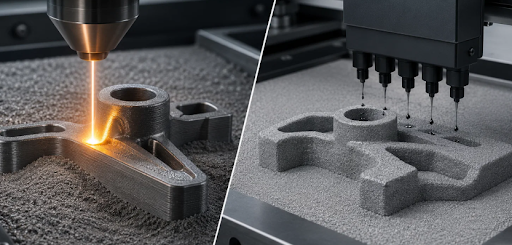
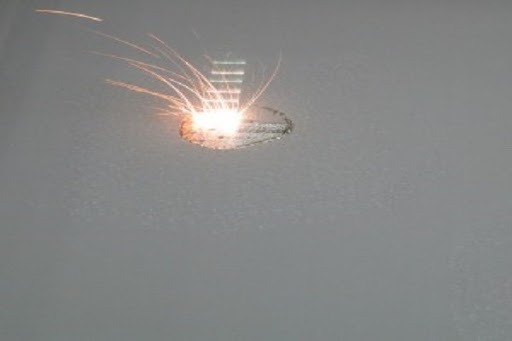
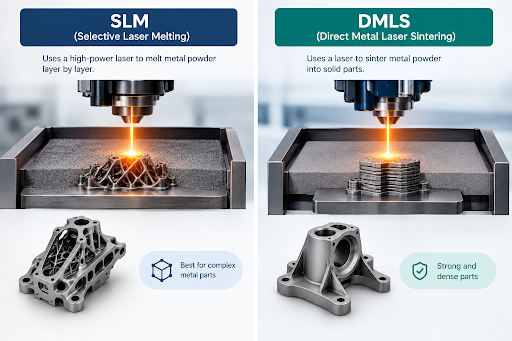
SLM uses a laser to melt metal powder completely in selected areas, creating a consolidated structure as each layer solidifies. This supports dense components with intricate geometries. DMLS is a widely used term for laser-based metal powder-bed fusion, particularly associated historically with EOS systems. Despite its name, DMLS can also fully melt metal powder. These metal additive manufacturing processes support the production of complex metal parts for demanding applications.
For example, engineers can use SLM to manufacture titanium aerospace brackets with integrated features that would otherwise require multiple machining operations.
What Are the Main Differences Between SLM and DMLS?
The distinction is not always a simple difference between melting and sintering. Both processes use laser energy to fuse metal powder, while the machine, alloy, and processing parameters influence the final properties. Understanding SLM and DMLS differences helps engineers evaluate which method suits their component requirements.
Key considerations include:
Material compatibility: Both processes can work with suitable stainless steel, titanium, and nickel-based alloys, depending on equipment specifications.
Component density: Optimised processing can produce highly dense parts with either technology.
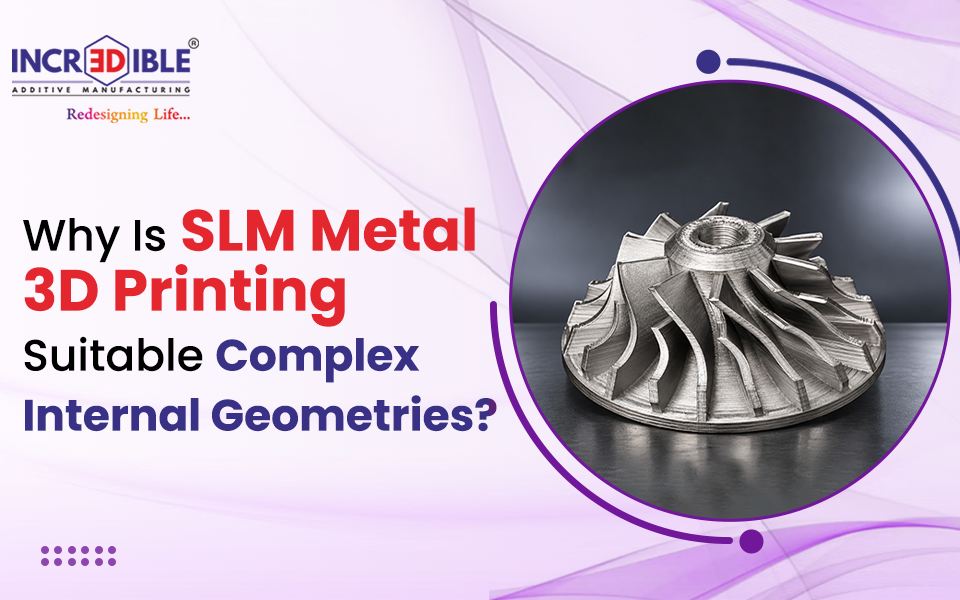
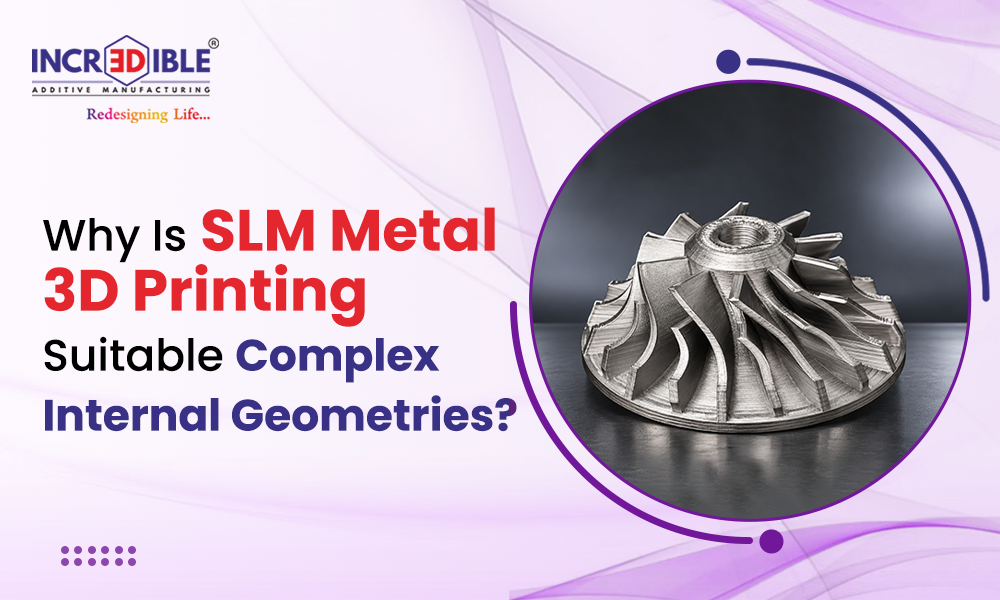
Design complexity: Both enable intricate geometries, internal channels, and part consolidation.
For example, conformal cooling channels in injection mould tooling can improve heat management and help shorten production cycles.
Why Do Material Properties and Precision Matter?
The chosen process affects how the component solidifies, develops its microstructure, and responds to post-processing. Laser power, scanning strategy, powder quality, and thermal management all influence porosity, residual stress, dimensional accuracy, and mechanical performance. The principles of selective laser melting are particularly relevant when evaluating how complete powder melting affects component formation.
“Precision depends on more than the printer; material selection, process control, and finishing matter equally.”
For aerospace brackets, medical implants, and industrial fluid manifolds, engineers must evaluate fatigue requirements, surface finish, and application-specific standards before approving a manufacturing route. They should also understand how direct metal laser sintering operates on the selected equipment and material.
How Does 3D Incredibles Support Complex Manufacturing?
3D Incredibles provides Metal 3D Printing services for components that demand design flexibility and precision. Its process begins with a CAD model, which is divided into thin layers for printing. Metal powder is spread across the build plate and selectively fused according to the digital design.
The company describes its near-net-shape manufacturing capability as achieving precision of approximately 0.2 mm, depending on the application and requirements.
“A well-planned digital workflow helps transform complex designs into functional metal components.”
Key Benefits of SLM and DMLS
Design freedom: Create intricate channels and internal features that conventional machining may struggle to achieve.
Part consolidation: Combine multiple components into one design, potentially simplifying assembly and improving reliability.
Material efficiency: Build near-net-shape components while limiting unnecessary material removal.
Faster iterations: Modify digital designs without manufacturing dedicated tooling for every revision.
Conclusion: Choosing the Right Process for High-Performance Components
4SLM and DMLS support demanding engineering applications by enabling complex designs, functional integration, and precise metal manufacturing. The best choice depends on the alloy, equipment, component specifications, and validated process capabilities.
Key takeaways:
Both support complex metal geometries.
Material and process parameters influence component quality.