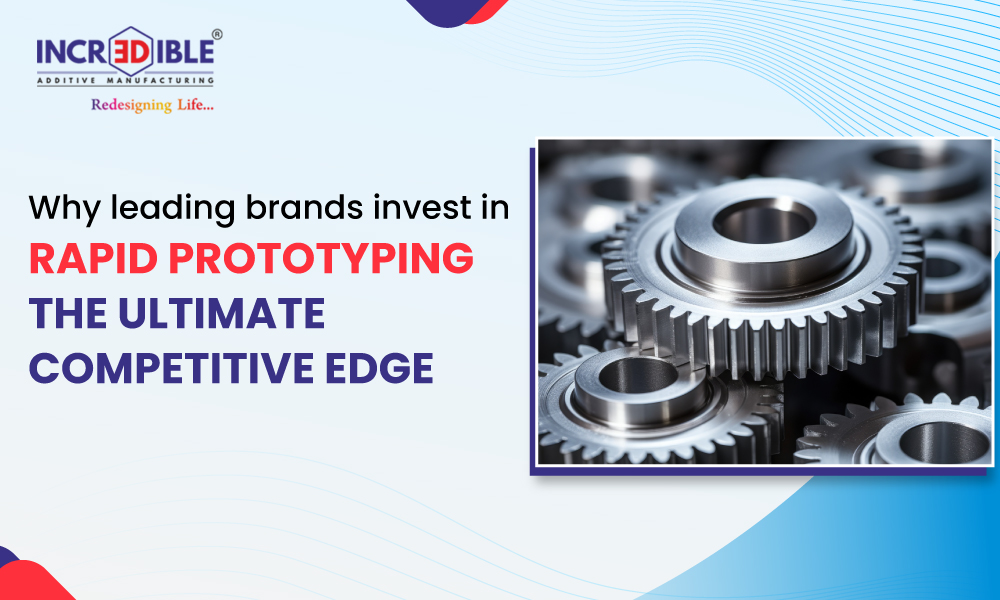
Brands that adjust swiftly react to changes fast, and sell products fitting today’s market are thriving in today’s business world. Rapid prototyping is one of the main reasons leading brands have achieved their success. Turning digital concepts into actual products immediately is enabling leading companies to develop their goods more efficiently. Developers quickly identify issues and find ways to solve them with the help of rapid prototyping. The result? More effective designs, a quicker time to deliver, and improved possibilities for creating products clients like.
Rapid prototyping shortens the journey from idea to product launch
Today, leading brands look beyond using traditional procedures for every task and want to avail the benefits of rapid prototyping. Ideas can be quickly displayed to people thanks to rapid prototyping. They are able to make prototypes, test them out, and improve their design before the final product is produced. Being able to develop their product quickly gives companies the chance to react to the market and customer views. Since timescales are shorter, both productivity and design options increase during the development process.
Testing and refinement happen faster and more accurately with physical prototypes
Rapid prototyping links the design process with the actual use of the product. With the fast creation of physical models through 3D printing, teams can check the product’s main features and how it is used by real people. Having quick insights allows spotting mistakes and making improvements before the low-quality items are manufactured. Because of this approach, the end result is better products, and developing them becomes easier. Thankfully, it makes it possible to test ideas practically, lowering uncertainty and, as a result, producing products of better quality before they are unveiled.
Customization becomes easy, and innovation thrives without traditional limits
Repeatable designs are possible in manufacturing, yet new concepts are hard to try until rapid prototyping came along. They are now able to design advanced systems, discover different sizes, and add specific features at a reasonable cost. Because they can change so often, brands have more opportunities to meet customers’ needs. Many types of experiments that were not safe or cost-effective to try in the past can now be done. Greater autonomy helps companies spring new ideas and create products suitable for particular groups of customers, allowing them to compete better in the market.
Why do leading brands see rapid prototyping as a risk-reduction strategy?
Because it allows teams to detect errors early and fix them without sinking time and money into flawed production runs. Testing products in various situations helps companies detect any usability or manufacturing problems early. It makes it less likely that the launch of new products will fail. It builds trust among stakeholders because the results used in decision-making have been proven to work. As one of the best benefits of rapid prototyping, the brain can make decisions fast and without spending too much money or encountering unwelcome surprises.
How does rapid prototyping boost collaboration across teams?
When the team can use the working model, understanding each other is easier. Then, because they are using the same prototype, experts from different fields are now on the same page. With ideas made clearer, team members no longer misunderstand each other and approve issues faster. Feedback loops tighten, and the shared vision becomes easier to execute. When this connection is made, it becomes much easier for the team to collaborate well while developing the product.
Conclusion
Making prototypes quickly is more valuable than just being a shortcut in the process. As a result, brand marketers can think smarter, introduce new campaigns sooner, and experience less risk, which helps create awesome new ideas. When companies take this approach, they are better able to compete with many others. Having built prototypes, they can experiment, better share their ideas, and keep finding new solutions. If a business is ready to grow, 3D Engineering provides advanced 3D printing that is quick, accurate, and easy to use. Using design allows organizations to introduce their concepts to the market quickly than others.